

When there is an original sound in the world, it makes a hundred echoes.
—John Shedd, American author
What is an original?
An original thought, idea, recipe, piece of art, fashion design?
I was thinking about that this week as I was making granola, tweaking and adjusting the recipe as I went. And it also got me thinking about where the brilliant idea for granola first came into being.
Origin stories
Granola was first called granula by its inventor, Dr. Caleb Jackson, who created it as a healthy breakfast alternative in 1863. Made of graham flour baked into sheets that were broken down and re-baked several times, the end product had to be soaked in milk overnight to be edible.
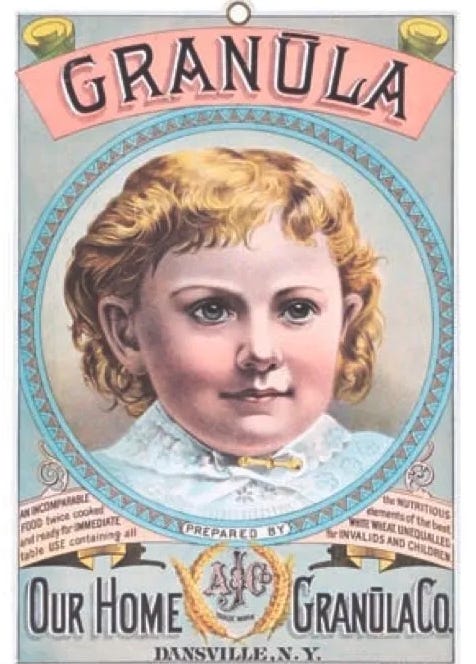
Milk and cereal - a completely original idea that sparked a breakfast revolution.
The concept of healthy grains for breakfast owed its next iteration to Dr. John Kellogg. Kellogg is usually credited with the creation of granola, a name he trademarked in 1878 (after Jackson threatened him with a lawsuit). Kellogg’s version used rolled oats and wheat flour and soon he was selling two tons of the stuff a week. That eventually led to cornflakes. I suspect Tony the Tiger and sugar-frosted flakes were not part of the original vision.
Then came C.W. Post. Post had granola while he was a patient at Kellogg’s sanitarium in the late 1800s. Fascinated by the sanitarium’s all-grain diet, Post first created Postum, an all-grain coffee substitute and then Grape-nuts in 1897. Post’s daughter, Marjorie Merriweather Post, would go on to helm a food empire to rival Kellogg’s (you can read here about the formidable Marjorie, who married four times, ran the business for 40 years, foresaw the potential of frozen food dinners in 1929, and died a billionairess).
Granola has long been associated with hippie culture, becoming shorthand for a generation that adopted a back-to-the-land sensibility and the dietary ideas to support it. Some stories claim granola was even airdropped to concertgoers at Woodstock, although the historical record is less certain. What is certain is that by the 1970s, good-for-you granola came into its own, cementing a permanent place at the breakfast table and beyond.
There is a vitality, a life force, an energy, a quickening that is translated through you into action, and because there is only one of you in all time, this expression is unique.
—Martha Graham, American choreographer
So what does this history of granola have to do with originality?
When I searched for granola recipes online, I got back 73,500,000 results. While many will be the same thing, presented different ways, many many more will be granola with a personal twist: more pecans; less honey; skip the coconut; use date syrup; add cinnamon, use tahini. That granola will be slightly different every time, under every hand that makes it. And all will be original ideas sparked by some dry sheets of graham flour first made in 1863.
Perhaps the most important thing about ideas and creativity and originality is that there will be many more failures than successes. The trick about ideas is knowing which ones to keep and which ones to throw out. As Linus Pauling, a Noble Prize-winning biochemist, said: If you want to have good ideas you must have many ideas. Most of them will be wrong, and what you have to learn is which ones to throw away. There’s only one way to find out whether something will work or not, and that’s to try it and fail first.
In the end, good ideas are always the product, and the benefactors, to one degree or another, to what has come before. The infinite echoes of our hive mind, busy at work producing creative honey.
If you enjoy these Dispatches—and I hope you do—tap the heart, share, or comment to help new readers find their way here
My favourite granola
adapted over and over again from The Cookbook: Fortnum and Mason, Tom Parker Bowles
serves 4, with delicious leftovers
Forget Jackson and Kellogg. The genesis of this particular granola is from Fortnum and Mason, or rather the absolutely smashing cookbook that Tom Parker Bowles wrote about F+M in 2016. The beauty of granola is its absolute flexibility. Don’t like pecans? Add more almonds. Love raisins? Stir them in at the end so they don’t dry out while baking. The possibilities are endless, which is the root of originality.
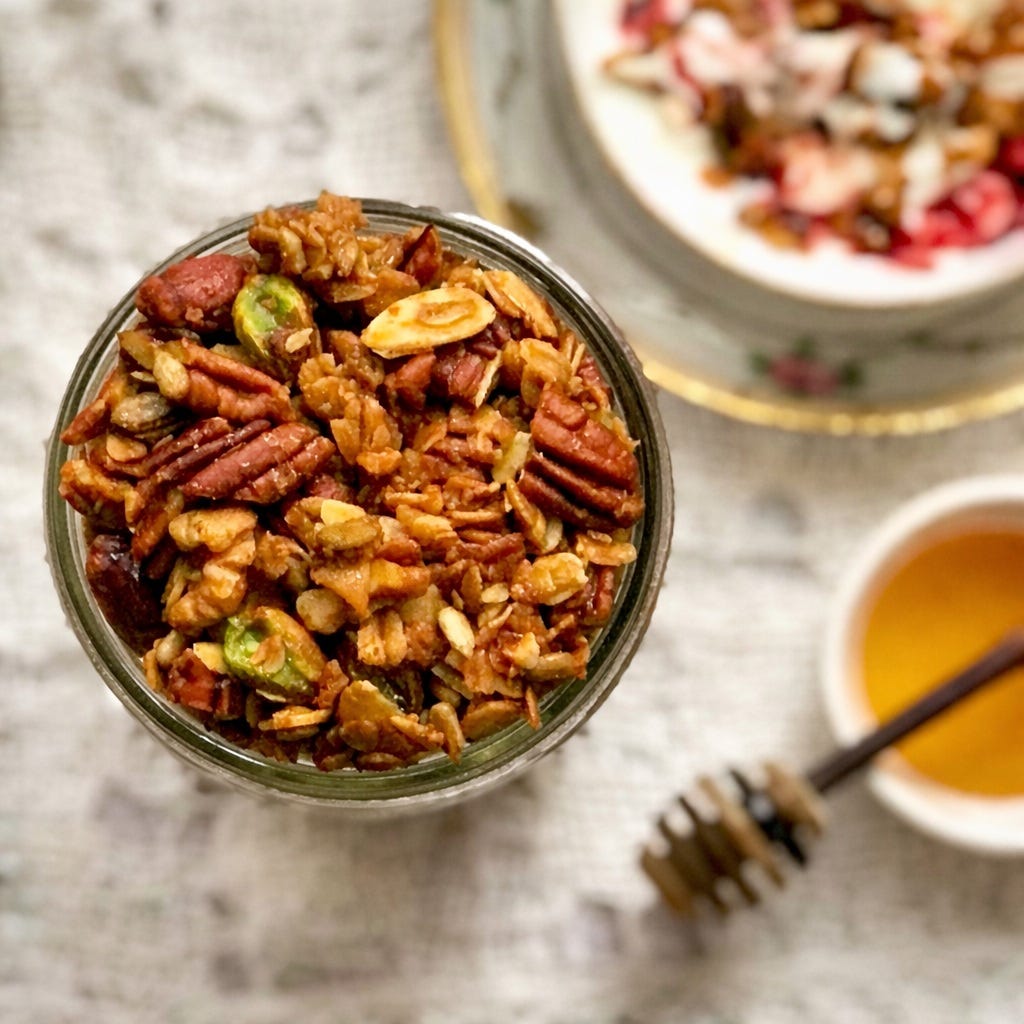
Ingredients
¼ cup/55 grams butter
3 tablespoons/60 grams honey
1½ tablespoons date syrup
¼ cup/55 grams Demerara sugar
1 teaspoon vanilla extract
½ teaspoon fine sea salt
Grated zest of two tangerines or oranges, plus the juice of one tangerine or orange
⅓ cup/40 grams chopped walnuts
¾ cup/75 grams chopped pecans
⅓ cup/40 grams raw pistachios
⅔ cup/50 grams flaked almonds
½ cup/70 grams raw sunflower seeds
1½ cups/125 grams rolled oats
Line a large rimmed 13x18 baking sheet, or two smaller rimmed baking sheets, with parchment paper. Heat the oven to 300F/150C.
Put the butter, honey, golden syrup, sugar, salt, vanilla, tangerine zest and tangerine juice in a small saucepan over low heat. Stir until the ingredients are all blended and the sugar dissolved. Set aside.
Combine all of the dry ingredients in a large bowl and stir until combined. Pour half the liquid mixture into the dry ingredients and stir to combine. Pour in the rest of the liquid mixture into the bowl and mix until everything is thoroughly coated (your hands are a good tool for this!).
Spread the granola evenly in the prepared baking sheet. Bake for 45 minutes to 1 hour, turning the granola every 15 minutes or so, until the mixture is golden brown. Leave the granola to cool on the baking sheet for 10 minutes, and then break it up with your hands until the granola is separated into small granules. Cool completely and store in an airtight container.
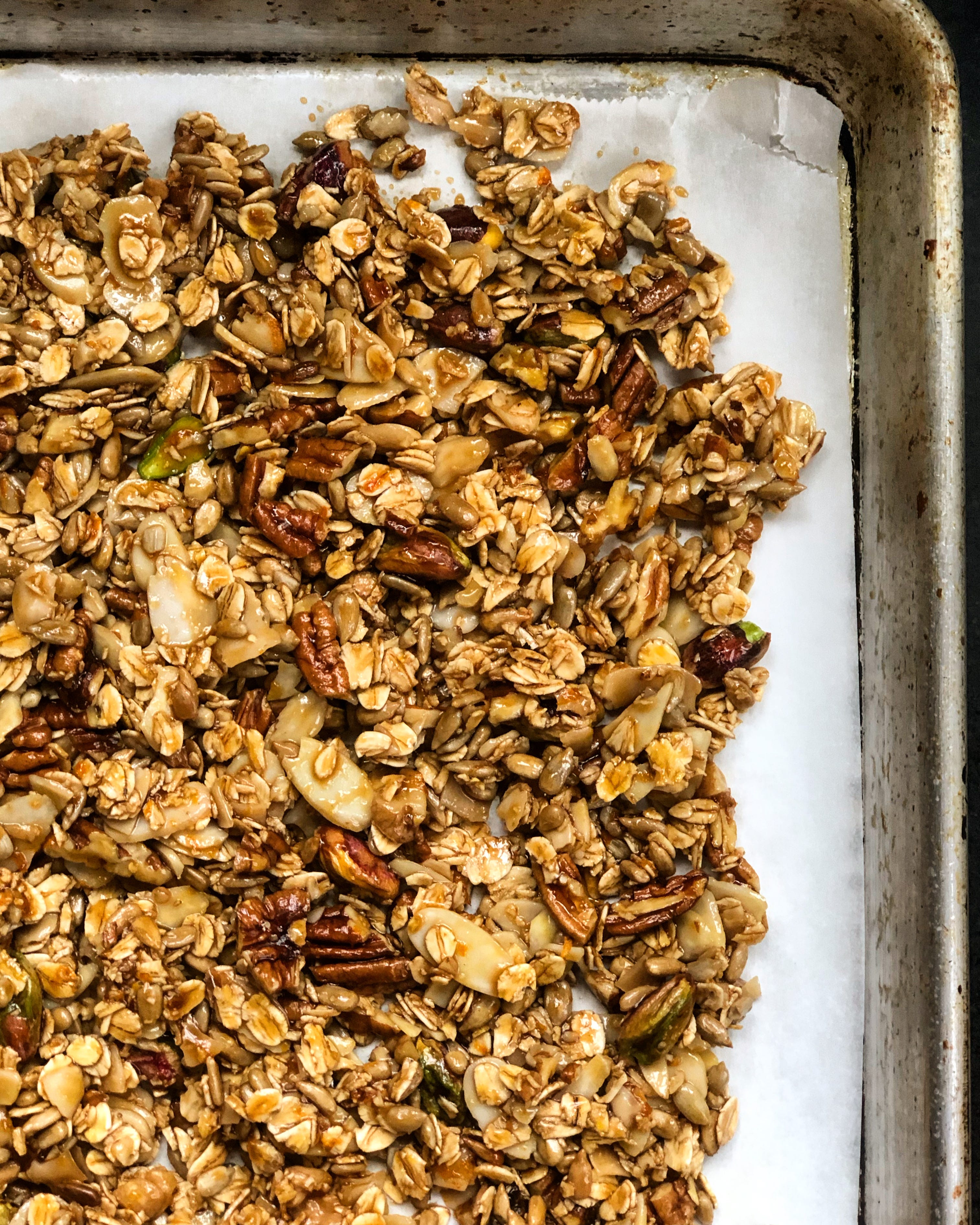
To serve:
Top plain yogurt with the granola, and add fresh berries, dried fruits, a drizzle of honey or a squeeze of tart cherry juice concentrate. Or just eat it by the handful - it’s a perfect energy boost any time of the day.
Check out some of my other favourite granola recipes from some of my favourite Substackers, including Shell Plant, Kerry Faber, Sarah Copeland and Lisa Golden Schroeder.


Wonderful! Thank you for the history and recipe, as well as initiating thought on “original”. When reading this I thought, “and for every famous person who was the ‘real’ inventor of something, there are scores of everyday individuals who’s grandma made something like it long before and didn’t get the credit!” Long live the simple and brilliant home cook!😍
The recipe I is use in my bakery is from a Vietnam war draft-dodging American ex-pat who somehow landed in Stratford. He and a couple of buddies started a granola making business in the '70's. After it had run its course, this led to his starting a health food store (which is still owned and operated by his widow). He asked me one day 20 years ago if I would make the granola for his business following the recipe he gave me.
I no longer make it for them, but we sell 25-30 pounds of it per week at the bakery.