
Keeping the faith
and a recipe for strawberry balsamic jam

To everyone new here, welcome. I’m Elizabeth, the writer of The Delicious Bits Dispatch, a weekly missive for the curious, blending discovery, reflection, and musings, always wrapped up with a seasonal recipe worth lingering over.
Me: “It’s too bad you don’t like jam.”
Him: “If you make it, are you going to eat it?”
Me: (considering)
Him: “Well, make it for someone else then. Give it away.”
Me: (still thinking)
Him: “When are you going to make it?”
Me: “This weekend,” I say confidently.
And that’s when a perfect stranger caught my eye and said:
“I have faith in you.”
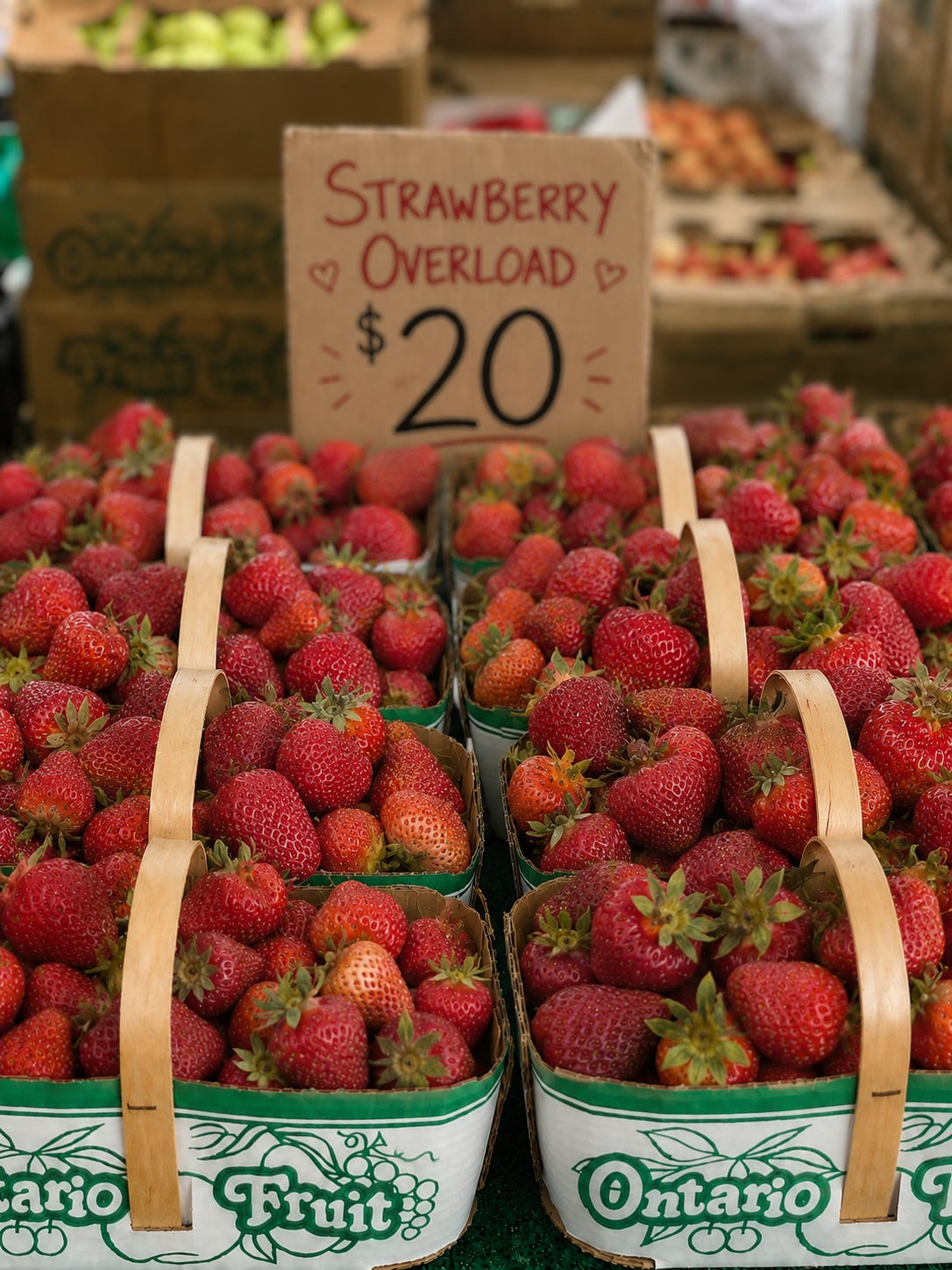
Perhaps she had witnessed my indecisiveness as I hovered over a large basket of strawberries that were just $20 (STRAWBERRY OVERLOAD! screamed the farmer’s sign), or overheard a fragment of what is surely a weekly exchange between me and Richard.
“I have a fruit situation at home too,” she said. It was like we had exchanged a secret handshake, our overflowing bags badges of honour to the bounty of summer.
And therein lies the dilemma of the seasonal eater, when the pure physics of balancing capacity, time, appetite, and perishability becomes an impossible equation. But then again, I was never good at science.
A full dance card
In the beginning there is rhubarb, followed closely by the radishes. Sometimes the asparagus surprises me by making an early appearance. Fiddleheads are fickle, morels even more so, making the clock watchers amongst us anxious by their absence. All of them invited to early summer’s debutante ball, shaking dirt and the memory of frosty nights off their bare shoulders.
Then the berries and peas come marching in, followed closely by cherries, and the sweetest baby carrots. By the time the stone fruit and the zucchini and the tomatoes and the corn show up, the most fashionably late of the group, I throw in the towel and buy everything.
Every week the struggle is the same... what to buy, what to leave behind, what to risk skipping that may not be there a week hence.
But if I’m being perfectly honest, the real struggle is to cook my way through the lot before it goes in the compost bin.
That’s where preserving can be a real friend in the kitchen.
Playing for keeps
It’s true that Richard doesn’t really like jam (although weirdly at a European continental breakfast he suddenly discovers its appeal). Nor are we big breakfast eaters, where well-buttered toast and marmalade or scones slathered with clotted cream and strawberry jam are welcome treats.
Yet still.
The appeal of canning, preserving, putting aside for future feeding…visions of my parents’ gleaming jars of passata, plum jam, pickles, peaches in syrup, filling our basement cupboards…the understanding that everything was saved and nothing tossed until its purpose was spent. All of that is hardwired and mapped in my mind, even though my intentions fall very short of the provisioning that was the hallmark of my thrifty childhood household.
Perhaps that’s why preserving still feels less like a kitchen task than an act of optimism. You’re betting that your future self will be grateful for what your present self took the time to do. A jar of jam isn’t just strawberries and sugar—it’s proof that abundance doesn’t have to end when the season does.
I don’t expect to live off my pantry all winter as my parents did. But, slowly, I'm building a repertoire of my own: bread-and-butter pickles, a rhubarb shrub that's currently chilling in the refrigerator, pickled cherries for those who just can't abide olives, and now this strawberry balsamic jam.
Opening a jar in February and tasting June feels a bit like cheating the calendar, each a gift and small promise that I'll find a use for summer long after the markets have packed up their stalls for the long winter ahead.
If you liked this post, let me know by clicking the ❤️ button, commenting, sharing or subscribing. It helps spread the word about Delicious Bits and brings me joy. Thank you, dear readers and eaters!
Strawberry balsamic jam
Eugenia Bone, Well Preserved
makes 4-5 250 ml jars
Canning is like having an investment or retirement fund in your pantry. You make small deposits over time, and there's a huge payoff in convenience, in flavor.
—Eugenia Bone
After a lifetime of learning the art of Italian cooking, preserving and foraging from her father, Edward Giobbi, a James Beard Award-winning chef and celebrated artist, Eugenia Bone wrote Well Preserved in 2009. Modernizing classic techniques and using current food safety knowledge. Well-Preserved is a practical manual dedicated to small-batch preservation with detailed explanations of both water-bath and pressure canning.
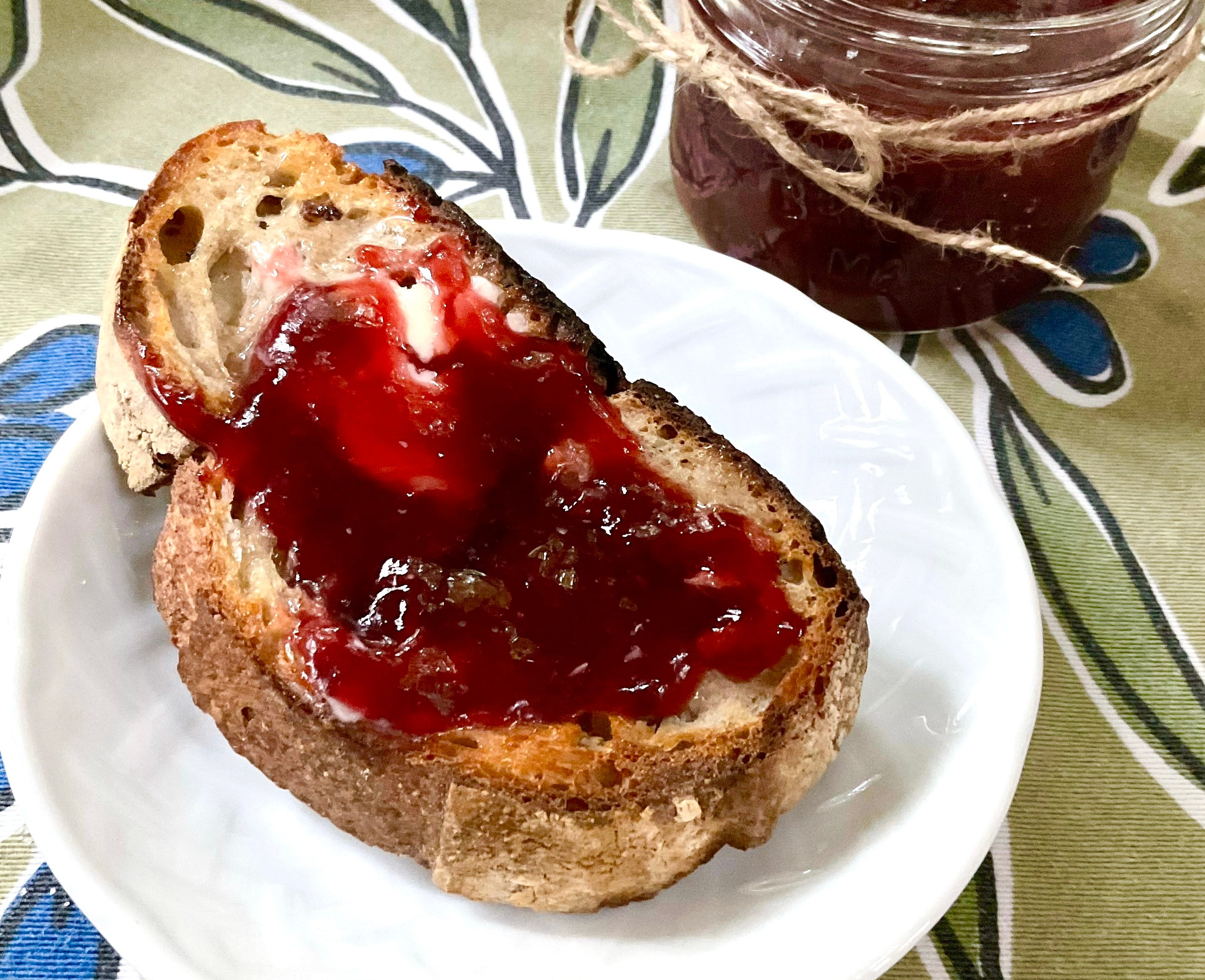
Traditional jam recipes can be surprisingly sugar-heavy, but this one uses a lighter hand. It's still unmistakably jam—sweet enough to spread on toast—but the strawberries remain the star, with the balsamic adding just enough depth to keep things interesting.
This delicious and sophisticated twist on strawberry jam is the perfect embodiment of why canning is worth it. I may just eat some myself instead of giving it all away.
About hulling strawberries
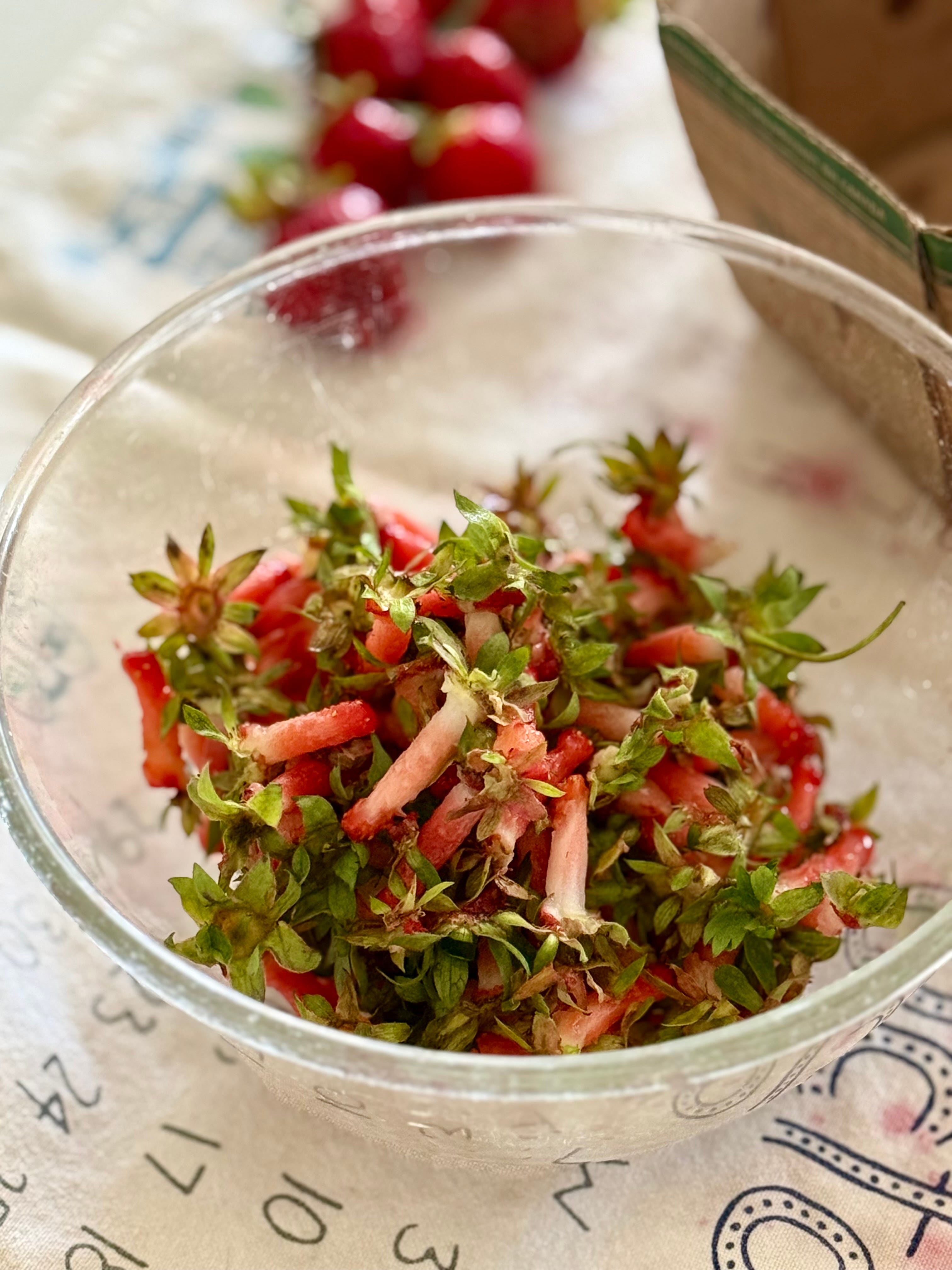
"Hulling" simply means removing the leafy green top and the small white core beneath it. I use a glass straw to poke it out from the bottom of the berry, but a plastic one (if you still have one hanging about) works just as well. A small paring knife or strawberry huller will do the job too.
Note: If you’ve not done water bath canning before, be sure to get familiar with the technique. This guide from Bernardin is a good one to follow.
Ingredients
8 cups washed, hulled and sliced strawberries (about 3 lbs), lightly mashed
5 cups sugar
½ teaspoon unsalted butter
5 tablespoons balsamic vinegar
Put the strawberries into a large, deep, heavy pot and bring to a boil over medium high heat. Once the strawberries are boiling, add the sugar and stir until it is dissolved. The sugar tends to burn on the bottom, so keep it moving until it is thoroughly dissolved. Bring to a boil and then add the butter (the butter helps to keep foaming to a minimum).
Turn the heat down to medium and keep the jam boiling at a merry bubble for one hour, stirring regularly, until thickened to a loose, soft jam or until a thermometer reads 220 degrees F, indicating that the jam has jelled properly. Depending on how much liquid the strawberries expel, the set time can be longer; start checking the jam’s consistency and temperature regularly at the one hour mark.
Fill clean, hot jars with jam, leaving ¼ to ½-inch headspace. Wipe rims and apply lids and rings. Process in a boiling water bath canner for 10 minutes (for 4 oz. jelly jars or 8 oz. half pint jars) or 15 minutes (for 16 oz. pint jars). Turn off heat and let jars sit in canner for 3 to 5 minutes before removing. Allow jars to rest on a dishtowel undisturbed for 6 to 8 hours or overnight. Check seals and store in a cool dark place for up to a year. If any jars did not seal properly, place them in the fridge and use first.
Nice post! And the conflict between the urge to honour fruit by preserving it and anxiety about taking on too much and wasting it is very real.
What a burst of summer!
You can save the strawberry tops and cores, dry them out completely (so they don't go mouldy) and use them to make a really yummy, really pretty tea.