
Moments of pleasure
and a recipe for a syrupy rhubarb upside-down cake

Rhubarb is a vegetable with the soul of a fruit.
There is something wonderfully improbable about rhubarb. After months of cold and dormancy, up it comes—vivid, vigorous, and seemingly indifferent to the season that preceded it.
Tart, crisp, long and colourful, rhubarb spreads like a weed, grows in the most inhospitable conditions, puts up with neglect, allows us to force it into existence and generally tolerates our bad behaviour. It is a plant that resists easy categorization: a vegetable that appears most often at dessert, a medicinal herb turned comfort food, a harbinger of spring that is harvested by candlelight in the depths of winter.
Cut into a fresh stalk and you are rewarded with an indefinable scent: green and fresh, sharp yet subtle, a whiff of freshly cut grass and a promise of good things. Oh what a thing of beauty.
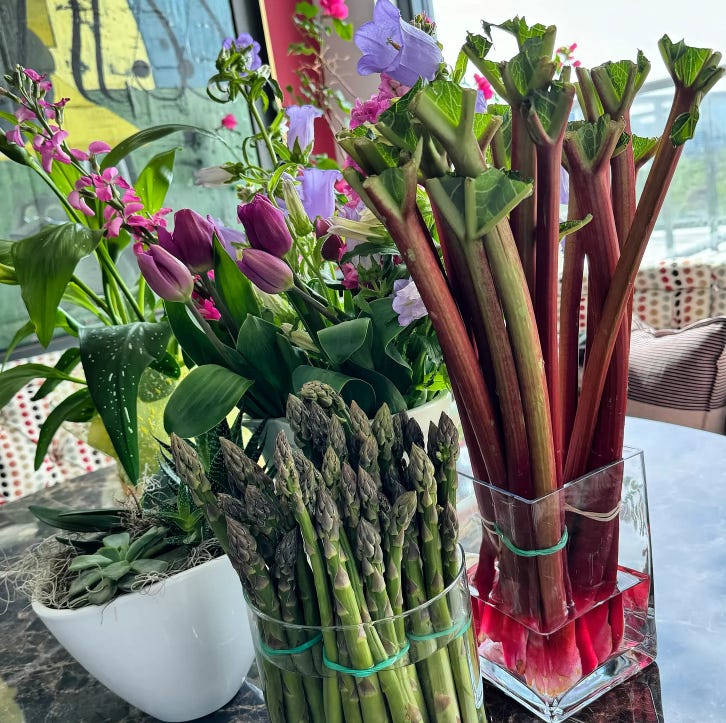
A seasonal centrepiece
Rooted in medicine, harvested by candlelight
Rhubarb fans are legion, nowhere more so than in Britain and North America, where this humble plant has found its way onto the dessert course for hundreds of years. But rhubarb didn’t start its journey as a compote, cake, cordial or jam.
The Chinese first discovered rhubarb’s astringency to be effective as a laxative. Greek and Roman writers recorded the medicinal use of rhubarb and transmitted the name through the Latin term rhabarbarum, from which the modern word ‘rhubarb’ ultimately derives: rheum, the plant genus of which rhubarb is a cultivar, and barbarum, the Latin for barbarian.
It wasn’t until the 1800s that rhubarb’s culinary prowess came to the fore. According to Dennis Duncan of High Altitude Rhubarb, widespread consumption of rhubarb began in Britain in the early 19th century, growing in popularity as an ingredient in desserts and wine making. With a short growing season, the discovery that rhubarb could be “forced” (grown out of season in the winter), caused its popularity to reach fever pitch, peaking just before World War II.
And this is where the most romantic part of rhubarb’s history comes into play.
The rhubarb triangle
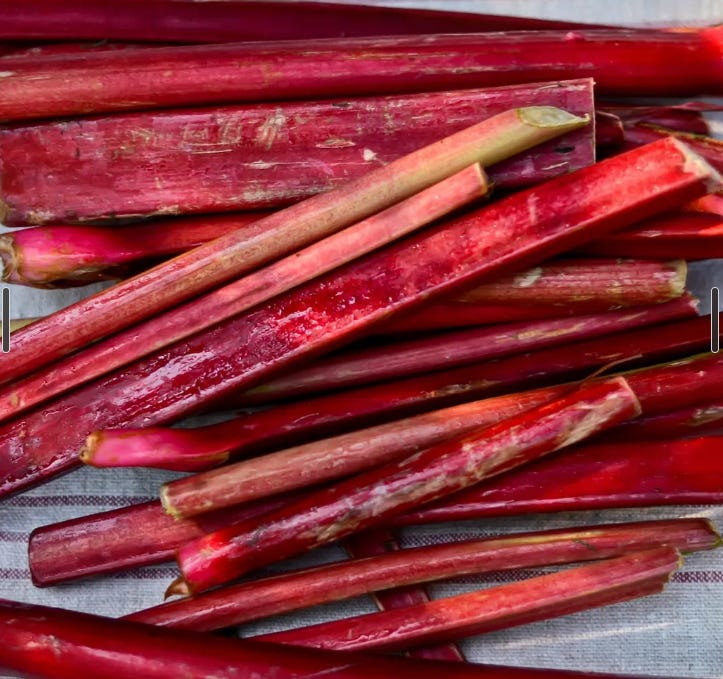
In long dark barns across a small patch of West Yorkshire, a great agricultural tradition continues. This is the “rhubarb triangle,” a nine-square-mile area between Wakefield, Morley and Rothwell. Here, from January to March, fuchsia-pink forced rhubarb, prized for its subtle flavour, is picked by hand, by candlelight, so that the delicate stems are not turned green and hard by photosynthesis.
from Mysteries of the Rhubarb Triangle, The Guardian
Forcing is not the exclusive domain of rhubarb. Greenhouses, cold frames, and hotbeds have long been used to satisfy our thirst for delicious things that are not “in season”. An advocate for buying asparagus in May and tomatoes in August, I’m not usually in a hurry to get something before Mother Nature delivers it. Yet the decidedly romantic Rhubarb Triangle in England makes the practice more palatable.
Forced rhubarb from the Triangle once made up nearly 90% of winter rhubarb. While the quantities are far lower today, Yorkshire’s fuchsia-pink, delicately flavoured stalks are still prized for making ruby-coloured treats. You can experience this delicacy at Wakefield’s annual Rhubarb Festival.
Across the Atlantic, rhubarb has inspired its own celebrations. In Sumner, Washington — the self-proclaimed Rhubarb Pie Capital of the World — summer arrives with Rhubarb Days, a festival devoted to ruby-red stalks in all their forms. There is something comforting in knowing that a plant is still capable of drawing crowds together in celebration. Few crops carry such a curious mixture of folklore, history, and affection.
Moments of pleasure
The Rhubarb Triangle, family desserts, spring itself—these are all layers of remembrance. Rhubarb is exactly that kind of trigger food: a smell, a taste, a colour that carries entire seasons and histories with it.
Perhaps that is why rhubarb inspires such devotion. Every spring, we greet it as though it were an old friend returned. We cut into those vivid stalks and find the same scent waiting for us: green and fresh, sharp yet subtle, a promise of good things.
Its presence marks not abundance but anticipation—the brightest note in spring’s unfolding song.
If you liked this post, let me know by clicking the ❤️ button, commenting, sharing or subscribing. It helps spread the word about Delicious Bits and brings me joy. Thank you, dear readers and eaters!
Rhubarb upside-down cake
adapted from Melissa Clark, The New York Times
serves 8-10
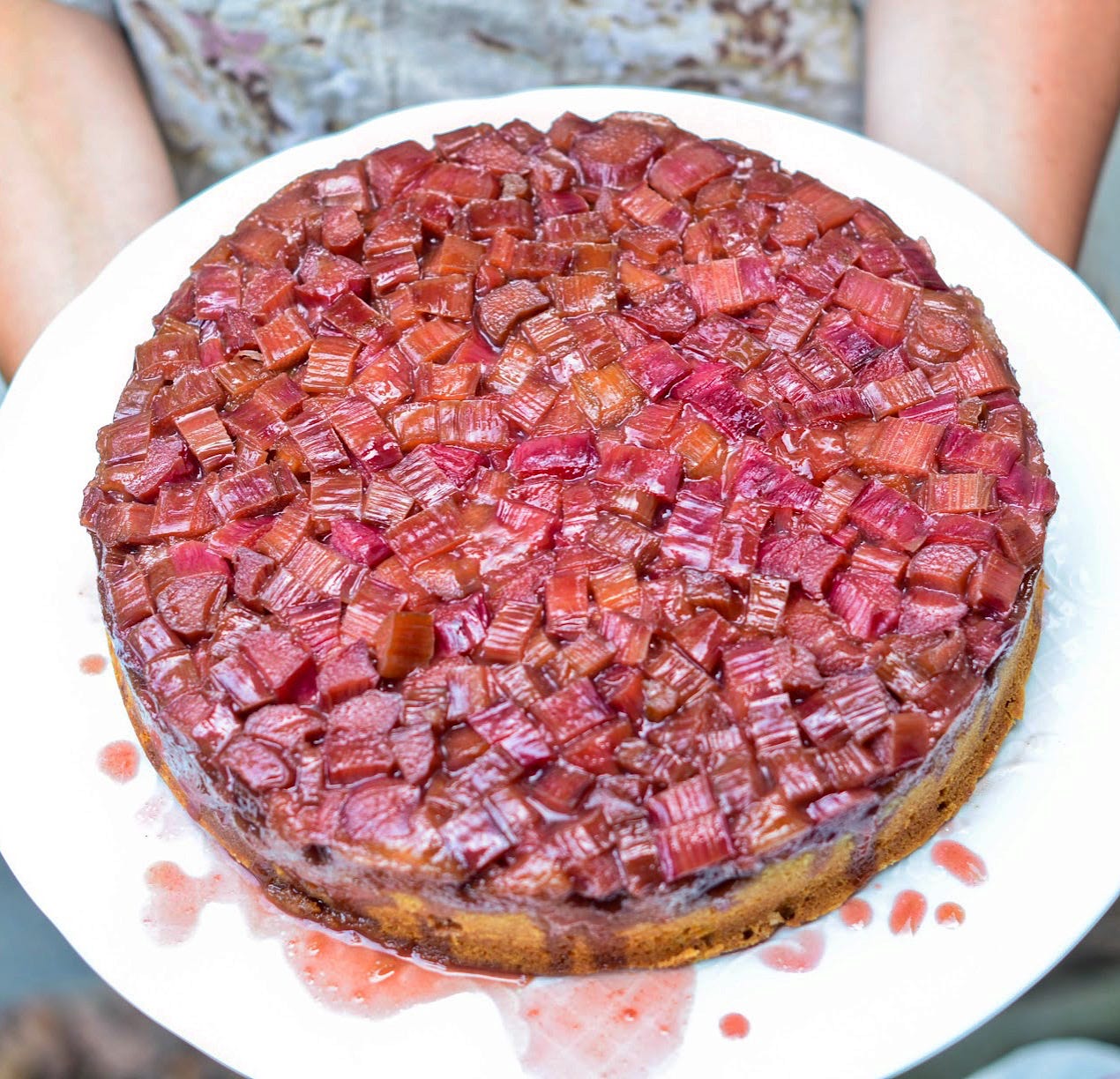
While strawberries and rhubarb have long had a love affair with one another, I prefer to give this most ephemeral of vegetables a starring role all of its own. Rhubarb comes in rainbow of colours, from the palest tender green to deep vibrant red. For this cake, try to seek out the deeper-hued stalks. They make for the prettiest topping.
Ever since this recipe appeared in the New York Times in 2011, I’ve made it at least a dozen times. The minute those long scarlet stalks of crisp-tart rhubarb appear at the market, I reach for this tried and true favourite. But what if it could be made better, easier and even more delicious?
With some modifications I now have the ultimate version of this spring classic. This buttery upside-down cake showcases rhubarb at its best: tart, jammy, and nestled beneath a tender lemon-scented crumb.
Note: Use a 9-inch cake pan with a minimum of 3-inch sides, as the batter rises generously during baking and the pan will be quite full. Once inverted, the cake settles considerably, but the extra depth is important while it bakes. Check the cake periodically toward the end of baking; if the top is browning before the centre is fully baked, loosely cover it with a piece of tin foil and continue baking until done.
Ingredients
2 sticks plus ½ stick (284 g total) unsalted butter, at room temperature
6 cups (680 g / about 1½ lb) trimmed rhubarb, cut into ½-inch pieces
2 tsp cornstarch
¼ cup plus ½ cup (150 g total) granulated sugar
¾ cup plus ½ cup (280 g total) light or dark brown sugar
2 cups (227 g) cake flour
1½ tsp baking powder
½ tsp fine sea salt
Zest of 1 lemon, grated
1 tsp vanilla extract
4 large eggs
⅓ cup full-fat sour cream
2 tsp lemon juice
Heat the oven to 325°F (165°C). Generously butter a 9-inch cake pan with a minimum of 3-inch sides (or a 10-inch cake pan with 2-inch sides) and line the bottom with parchment paper.
Put the rhubarb in a medium bowl. Whisk together the cornstarch and ¼ cup of the granulated sugar, sprinkle over the rhubarb, and toss to combine. Set aside.
In a medium bowl, sift together the flour, baking powder, and salt. Set aside.
In a small bowl, rub the lemon zest into the remaining ½ cup granulated sugar with your fingers until fragrant and evenly combined.
Using a stand mixer fitted with the paddle attachment, cream 2 sticks (227 g) butter for 2 minutes. Add the lemon sugar and ¾ cup brown sugar and beat on medium-high speed until light and fluffy, about 4 minutes, scraping down the bowl as needed. Beat in the vanilla, then add the eggs one at a time, mixing well after each addition. Mix in the sour cream and then the lemon juice. The mixture may look slightly separated, but it will come together once the flour is added.
With the mixer on low, gradually add the flour mixture and mix just until combined, scraping down the bowl as needed.
In a small skillet over medium heat, melt the remaining ½ stick (57 g) butter and the remaining ½ cup brown sugar. Whisk together until smooth and bubbling, about 2-3 minutes. Pour into the prepared cake pan, then spoon the rhubarb and any juices evenly over top.
Spoon the batter over the rhubarb, covering it completely, and smooth the top. The pan will be quite full, but the cake will bake up beautifully.
Bake for 1 hour 15 minutes, or until the top is firm and springs back lightly when touched and a toothpick inserted in the centre comes out clean. If the top is browning before the cake is fully baked, loosely cover it with foil and continue baking, checking every 10 minutes.
Cool the cake in the pan on a wire rack for 20 minutes. Run a knife around the edge, place a serving plate over the pan, and invert the cake while still warm. If any rhubarb sticks to the pan, simply scrape it onto the top of the cake. Let cool for about 1 hour before serving.
What a gorgeous centerpiece of cut rhubarb! And I love that you used solely rhubarb in this tart. I’m honestly not a fan of rhubarb and strawberry together (maybe because rhubarb is gone before strawberries really come into season, at least where I live) but just rhubarb as the star is something I can get behind! So lovely, Elizabeth!
My local market sold soft pink forced rhubarb! I hadn’t heard of that before. Dreamy!