

To everyone new here, welcome. I’m Elizabeth, the writer of The Delicious Bits Dispatch, a weekly missive for the curious, blending discovery, reflection, and musings, always wrapped up with a seasonal recipe worth lingering over.
This is the final piece in a three-part reflection on how we grow and change, often outside the timelines we imagine for ourselves. If the first explored blooming more than once, and the second invited us to see more clearly what has been present all along, this last post asks a deeper question: what happens when clarity begins to shape our choices?
→ Read Part One → Read Part Two
Over dinner with friends recently, the conversation drifted to what happens when we go.
Some were firmly in the camp that once you die, that’s it. No afterlife, no heaven or hell. Others believed that energy is infinite: that the life spark that gives us breath returns to the ethos, becoming part of the greater whole.
Still others were in the past lives camp, the notion that we’ve been here before, some of us many times. Old souls vs. newbies, reincarnating until we get to a final state of nirvana.
As I listened to the debate, I wondered whether our belief has any material impact on how we’re living today, in the here and now. If you believe you’ll be back for a second round, is there less of a sense of urgency? If your energy is part of the greater cosmos, are you more attuned to the earth’s cycles, the ebb and flow of the ocean, the movement of the stars? And if you think this is your one and only time around the sun, are you grabbing every opportunity, every moment with both hands?
While I don’t know where I really sit on the debate, my inclination has always been that this one wild and precious life is about more: more experiences, more adventures, more boxes checked. Making the most of every moment.
But is that really the goal? In the race to get to everything on my ever-growing bucket list, what might be called for instead is a pause.
If the earlier parts of life are about building and blooming, and later parts about seeing to seek understanding, perhaps this stage is about discernment: deciding what deserves our energy and our presence.
The bucket list
Although it seems ubiquitous now, the term “bucket list” first appeared in 2007, after the release of the movie of the same name. The plot revolves around two terminally ill men, who meet as hospital roommates. When one writes a list of things he wishes he had done, the other insists they go out and do them.
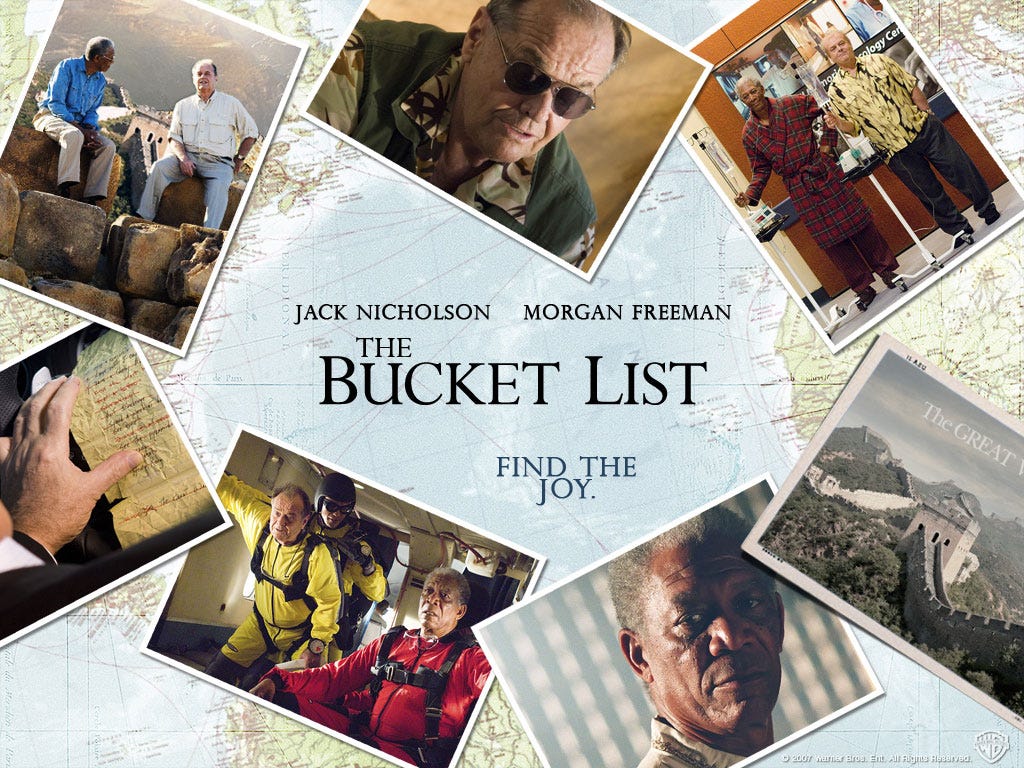
That journey ultimately becomes less about crossing things off the list and more about confronting regret and repairing relationships, redefining what makes a life a well-lived one.
The notion of fulfilling our dreams and finding something deeper through a bucket list immediately captured the collective imagination, becoming a mainstream life-planning concept in the process.
The bucket list quickly evolved into experience badges of honour and Instagrammable achievement. “That’s on my bucket list” came to encompass everything from eating at a top-rated restaurant, owning a coveted car and seeing the Pyramids to learning to scuba dive or climb Mount Everest. Moving from meaning into consumable aspiration, we went back to ticking off boxes and bragging rights, making that the main event instead of the experience itself.
The idea of finding joy—the film’s tagline—quickly got lost in the quest for more.
About the same time, as part of a company-wide innovation program where I worked, every employee was asked to create a bucket list of things they’d like to do. The lists were posted outside each office door—an instant and unexpectedly personal introduction to who was inside. Long after the program faded, the lists remained, sparking conversations in hallways and over coffee.
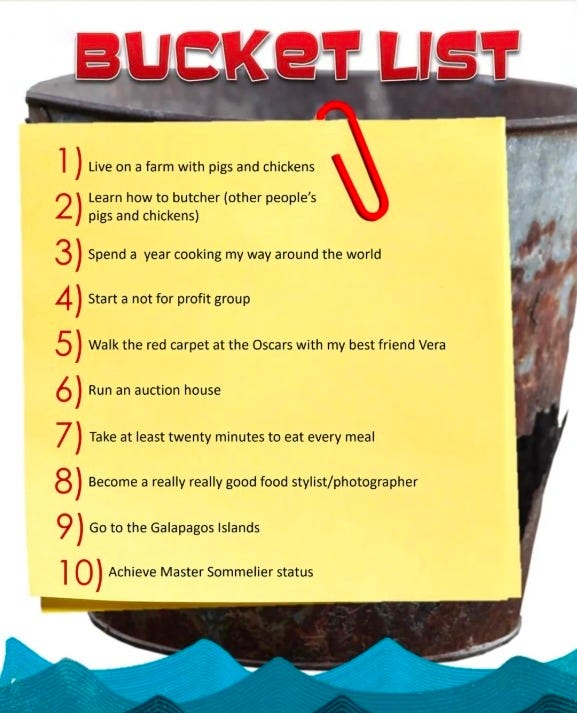
What a difference a life makes.
Shall I tell you that I did not check off a single item from that long-ago list?
And shall I also share that a richer, fuller life has emerged — not because I abandoned that list, but because I’ve come to discern that not everything is worth doing? When you use a finer filter, what remains is a purer substance. Not fewer choices, but infinitely better ones.
Now is the time to know that all that you do is sacred.
—Hafiz, 14th century Persian lyric poet
Perhaps this is what these past weeks of reflection have really been about.
First, trusting that we don’t bloom just once, that there is no single moment in which our lives must crystallize. Then, learning to see more slowly and recognise what has been present in us all along. And with that clarity, finally, choosing with intention, comfortable in the knowledge that what we do becomes who we are.
In the cacophony of a world that seems to be hinging off its moors with increasing speed, it’s easy to feel adrift, to clutch at things that on the surface feel thrilling but ring hollow. How grounding to remember that not everything must be done.
Life does not deepen through accumulation, but through attention—through recognizing what has meaning and allowing that to shape our days. Discernment becomes expansive, filling our hearts with joy.
If you enjoy these Dispatches—and I hope you do—tap the heart, share, or comment to help new readers find their way here
Butternut squash & lentil stew
recipe and photo credit: Nicki Sizemore
This wonderful stew may have a long list of ingredients, but it takes no time to assemble and put in your slow cooker for an aromatic and hearty dinner. This recipe from Nicki Sizemore is part of a compendium of fantastic curry recipes gathered by Lisa McLean and Annada D. Rathi — you’ll find the link below to explore.

For the base:
2 tablespoons virgin coconut oil or extra virgin olive oil
1 small onion, finely chopped
Salt and freshly ground black pepper
1 large garlic clove, finely chopped
1 tablespoon finely chopped ginger (from a 1-inch knob)
1 tablespoon ground cumin
1 teaspoons curry powder
½ teaspoon red pepper flakes
For the stew:
4 heaping cups cubed honeynut or butternut squash (from 2 pounds of squash)
1 cup green lentils, rinsed in cold water
1 14-oz can full fat coconut milk
1 14.5-oz) can diced tomatoes
⅓ cup finely chopped dried Turkish apricots
1 cinnamon stick
1 bay leaf
3 cups low-sodium vegetable or chicken broth
2 tablespoons fresh lime juice
Heat the oil in a medium skillet over medium-high heat. Add the onion, and season with salt and pepper. Cook, stirring occasionally, until slightly softened, about 3 minutes. Add the garlic, ginger, cumin powder, curry powder, and red pepper flakes, and cook until fragrant, about 1 minute.
Do Ahead: The aromatics can be cooked 1 day ahead. Let cool, then cover and refrigerate.
Scrape the onion mixture into a 4- to 7-quart slow cooker. Add the cubed squash, lentils, coconut milk, drained tomatoes, chopped apricots, cinnamon stick, bay leaf, and broth. Season with salt and pepper. Cover and cook until the lentils are tender, 7 to 8 hours on low or 3 to 5 hours on high.
Stir in the lime juice, and season the stew well with salt and pepper. Ladle into bowls and serve.
For more great curry recipes, explore below!

This is the wisdom of having lived through all that came before, Elizabeth. All of the striving, ignoring of inner voices, the joyful carefree jaunts through life, and the search for meaning and truth, and so much more. We arrive at a gentler place, with compassion faceted by the precision of life.
A thoughtful and stimulating piece again Elizabeth, as always thank you for sharing your beautiful mind. And of course my gratitude for sharing the Curry Night post.
I loved this part:
“First, trusting that we don’t bloom just once, that there is no single moment in which our lives must crystallize. Then, learning to see more slowly and recognise what has been present in us all along.”
And I knew about the movie, but not that it’s where the saying comes from (I thought the movie was named after the saying). Also, I’m gonna have to try this stew!